品川の水族館ー The Aquarium
I went to the Aquarium in Shinagawa with one of my Toshiba friends and her friend from university. Shinagawa aquarium has several aquariums featuring fish from freshwater rivers, to the sea, to exotic fish from other places. It has a really neat walk-through aquarium too, where we saw a diver go in and feed the sting-rays. We also saw a dolphin show which was a lot of fun, as well as a sea lion show.
Shark!
We rowed around the pond in a rowboat.
Seafood doria for lunch
Here I am with a blue whale statue
Grave for whales
Japanese curry for dinner!
Monday, July 16, 2012
Saturday, July 14, 2012
カトリック教会ー Catholic Church
A few weeks ago I saw a sign for a Catholic Church here in Tsurumi, and I was so excited to be able to go to Mass in Japanese. So every time I rode the bus and passed by the sign I tried to read it to figure out where the church is located. Finally it dawned on me to google it- much easier. So I found the directions and today I went to mass.
On the way there today, walking through a little neighborhood, I found a tiny Shinto shrine. It is funny how there are shrines everywhere! I have seen them in the middle of cities next to department stores, office buildings, and residential areas like this one. I have been told that perhaps the shrines were bigger at one time, and when the area was built up around them people avoided moving the shrines so as to respect the feelings of the gods. So... there are shrines everywhere. This one was extra cute though, as it is set in the middle of a pond.
I found the Catholic Church very easily. It is very close to my dormitory- only about a ten minute walk away. Once I arrived I wandered around a little and found a very pretty ornamental pond in the courtyard that had a little chapel hiding behind it. Next I went to the main building and walked through the quiet, dark building wondering where the sanctuary was. In the lobby I found an Indian lady and her little daughter waiting for her husband and son to arrive. So I talked to her until the rest of her family came and then we walked upstairs for mass together. They were very kind and showed me where everything was and after mass introduced me to the priest. It was really neat to hear mass in Japanese, and I understood everything the priest said pretty well (of course that's not the hardest task since Catholic masses all follow the same format!). It was the smallest mass I have ever attended though, with only about 15 adults and 5 little kids. The recessional song had the same tune as one we sing in English, so that was pretty awesome. I was able to follow along and sing to it from the Japanese hymn book.
Monday, July 9, 2012
バービークュー
On Sunday I had a barbecue with several people from Toshiba. It was held at the house of a lady that has a yard, a not so common possession here in Tokyo. The garden (that is the term Japanese use to refer to yard) is about 12 ft by 35 ft, and that is considerably spacious in Japan! It was very pretty though, with bushes and trees, and a gorgeous green grass (hey, something not so common in Texas!). They actually have a vegetable garden as well right next door, and when everyone was leaving they shared fresh vegetables just picked from the garden. We grilled lots of delicious food (beef, chicken, pork, mushrooms, eggplant, etc. and had rice, salads, cake and donuts too), socialized, and played with the kids all afternoon. It was so nice to spend a calm Sunday afternoon with the people I worked with, getting to know everyone better and seeing everyone away from the office. As I mentioned some people brought their little kids, so it was a very relaxing, family-oriented affair.
Playing with my co-worker's little daughter.
Almost everyone from my group at Toshiba!
Sunday, July 8, 2012
七夕のパーティー!
The seventh of July is Tanabata, which means evening of the seventh. This day is a festival in Japan honoring the meeting of two deities that are represented by stars. According to the legend, these two lovers are separated by the milky way and can only be together on this night every year. So... yesterday I attended a Tanabata party thrown by some of my friends here!
So in the afternoon I went to my friend's apartment where she invited everyone to go get dressed up for the party in the evening. On the way there, I missed a street I was supposed to turn on so I asked a girl I saw if she could tell me which way to go. She said she did not know the place exactly so she decided to walk with me and find it, even though she had just arrived at her own apartment and it was raining! We were in the same neighborhood so luckily it was not far. Another one of the many acts of kindness I have received while staying in Japan!
At the apartment, we dressed in yukata and got our hair and makeup done. This was a yukata party, so almost everyone, boys and girls, came dressed in yukatas. Yukatas are a light, cotton, summer version of the kimono. Yukatas are very popular apparel for summer festivals, parties, and when you go see hanabi shows (fireworks).

Around 6:30 everyone headed to the place where the party was held. As we walked in they divided us into teams to play games, and we wrote out tanzaku. Tanzaku is a tradition where you write your wish down on a slip of paper and then hang it on a bamboo branch for the night so that your wish will come true.
Next we started the games. First we played an imagination game, where the emcee gave a topic or keyword and the players wrote down the first thing that came to our mind when we think of that word. Then when we are ready we show our teammates, and if any of us wrote the same thing we won points for our team. For instance, given the word "Ghibli," several people on my team wrote down "Totoro." The next game was darts, pretty straightforward. Last we had a senko hanabi race. Senko hanabi are very popular fireworks in Japan. They are very similiar to sparklers because they are small and hand-held, however the flame smolders and produces miniature fireworks until the ball of fire just drops to the ground and is over. So the person whose flame burned the longest won.
Senko Hanabi!
Sadly my team did not win the tournament, but we socialized and I made several new friends during the festivities, so it was a great night! Definitely one of my favorite memories of my first trip to Japan.
Tuesday, July 3, 2012
Japanese-Mexican food
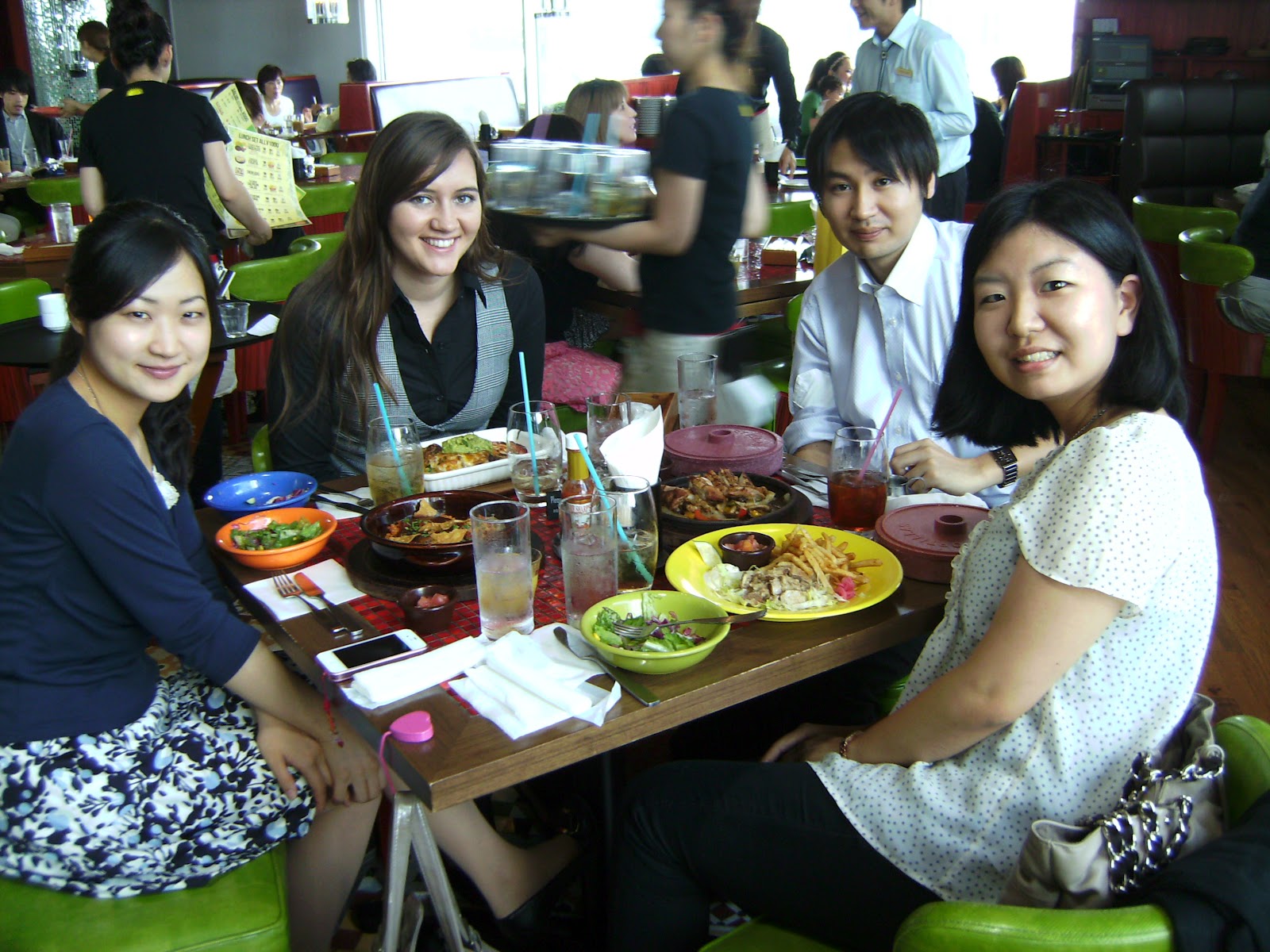
Yesterday we had a half-holiday at Toshiba, so I had lunch with three of my acquaintances from Toshiba. We went to a Mexican restaurant in Daikama, which is a ritzy little station near Shibuya. I actually expected the food to taste completely different from Mexican food in Texas, and although it was served very differently, it tasted quite similar to Mexican food in America. Here they don't serve entrees with rice and beans like we do in Texas. Instead there is rice underneath the entree, and we were served a salad and a cup of squash soup. For dessert we had mango cheesecake. It was delicious and a fun lunch!
During lunch I was given a detailed explanation of the doki social system. Your doki are the people who entered the company the same year as you; with doki you eat lunch, hang out, and consider them to be your "work friends." Senpai are your seniors, so anybody older than you or entered the company before you. To your senpai you speak in keigo (formal language) to show respect. Last there is kohai, people who entered the company after you. To these people you speak in casual language. Generally people in the company do not consider senpai or kohai their "friends," although they may spend social time together. I have come to the conclusion that the way we define and use the term friend, is different in America than it is used in Japan. Even just one year of age difference is very important and determines the senpai-kohai relationship between people. In Japanese culture there is a lot of importance placed on age. Apparently, you are expected to use keigo with people older than you, even if you have a higher in rank within the company. However with friends from outside the company, in many cases age does not determine the language you are expected to speak with, and you can speak more casually.
I ate enchiladas, a little bit different than how they look in America!
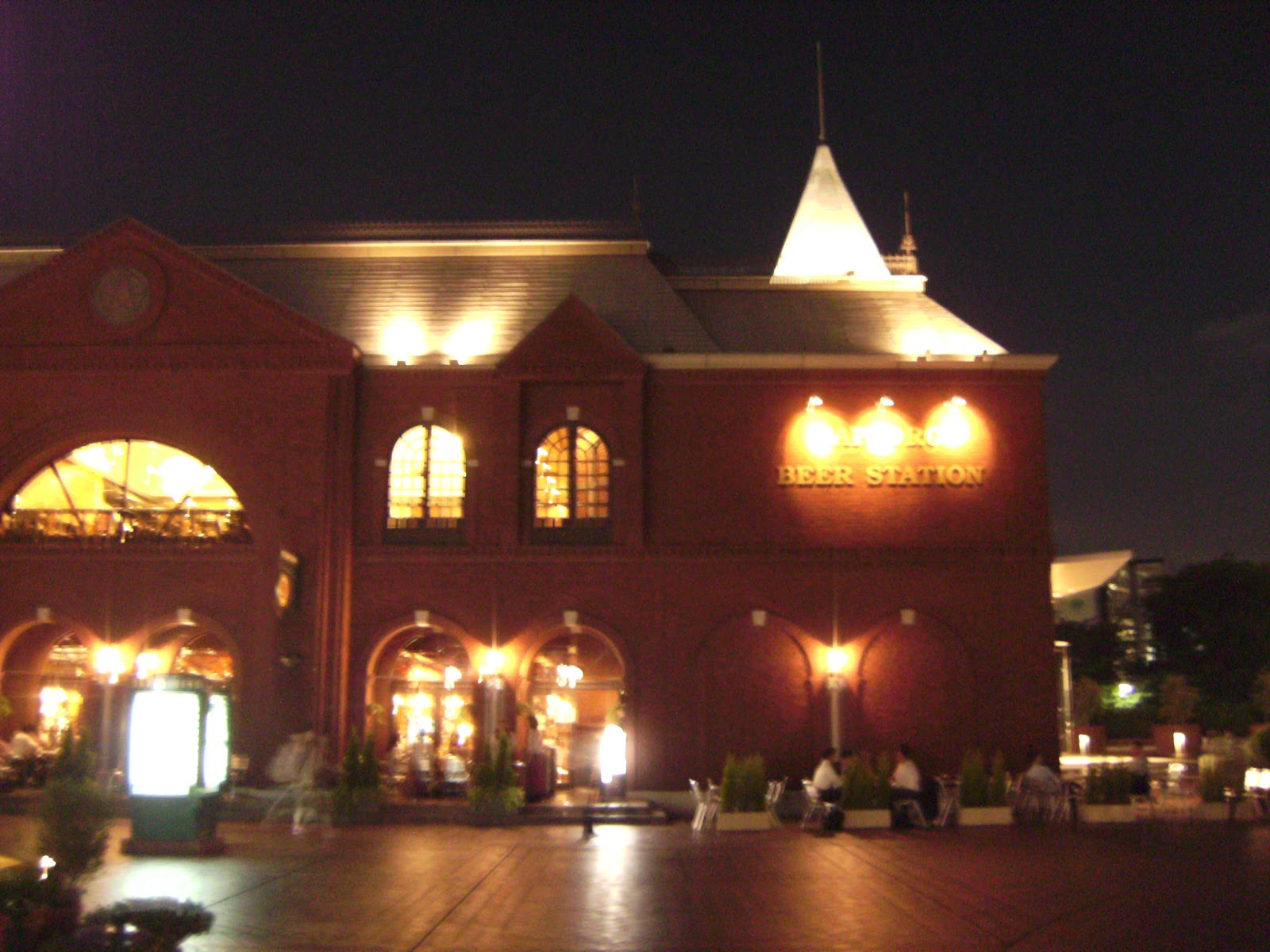
In the evening I went to Ebisu with one of my Toshiba friends. We went to the Ebisu Beer Garden, which is a little restaurant famous for serving factory-direct, fresh Sapporo beer. The area in that station is also very fancy and pretty at night.
Sunday, July 1, 2012
浴衣ー Yukata Shopping!
Today I went on a mission to find a yukata. I started in Harajuku where I know a store that sells inexpensive yukatas. However when I was looking there I realized that most of their yukatas are the modern type which is easier for westerners to wear. Their selection of the longer, more traditional type of yukatas consists of five color choices, but they are only about $50. (They also have a floor where they sell antique yukata, kimono, etc but that was too expensive for me!) Furthermore, they did not have hanhaba obi available, which is the type of obi that is worn with summer yukatas.
So I decided to go to Shibuya and check the department stores, this is yukata season so they are available in stores right now. So I ran into my next problem, yukatas at department stores have prices ranging from $150-$375. Hmm, だめ。But what they do have is a large selection of colors of obis and other accessories.
So I decided to go back to the first store in Harajuku, and buy one of the traditional yukatas from there. Then I returned to Shibuya again and picked a pretty obi to go with my new yukata. My obi ended up being twice as expensive as the yukata! But its ok, because the outfit turned out really well, I can't wait to wear it out next weekend.
So after 6 hours of shopping, I returned home to play dress up!
Also, for lunch I ate at a Thai restaurant in Harajuku- I had chicken with green coconut curry, おいしい!
Today I went on a mission to find a yukata. I started in Harajuku where I know a store that sells inexpensive yukatas. However when I was looking there I realized that most of their yukatas are the modern type which is easier for westerners to wear. Their selection of the longer, more traditional type of yukatas consists of five color choices, but they are only about $50. (They also have a floor where they sell antique yukata, kimono, etc but that was too expensive for me!) Furthermore, they did not have hanhaba obi available, which is the type of obi that is worn with summer yukatas.
Harajuku Station
So I decided to go back to the first store in Harajuku, and buy one of the traditional yukatas from there. Then I returned to Shibuya again and picked a pretty obi to go with my new yukata. My obi ended up being twice as expensive as the yukata! But its ok, because the outfit turned out really well, I can't wait to wear it out next weekend.
So after 6 hours of shopping, I returned home to play dress up!
I figured out how to fold the obi to make the belt and bow two-tone!
Yes, I tied that bow all by myself.
Also, for lunch I ate at a Thai restaurant in Harajuku- I had chicken with green coconut curry, おいしい!
Saturday, June 30, 2012
日本の料理ー Japanese Home style Cooking!
Today I went to one of my co-worker's house with two other ladies and we had a little afternoon feast. I learned how to make Chinese dumplings and chirashisushi; this was a lot of fun since I love cooking. I already ordered a Japanese cookbook a few weeks ago, and cannot wait until I can begin cooking from it. We also ate spinach, black miso soup (versus the more commonly known white, black miso is from the Nagoya area), olives, and more. It was a delicious meal! A dessert of sweet potato treats and pineapple pound cake followed, with tea and iced coffee to drink. We then spent the afternoon chatting, talking about cooking, looking at cookbooks, etc. It was a really pleasant day and I enjoyed being able to experience the relaxed, at home atmosphere.
My cooking teacher and me! I am fanning the rice while she stirs it, apparently that is a vital part of the process.
Here I am making the egg topping for the sushi, I cooked and flipped it without tearing it at all- which takes skill.
Here- making Chinese dumplings.
Our feast! ( Well some of it, there was more added later)
おいしい!
Subscribe to:
Posts (Atom)